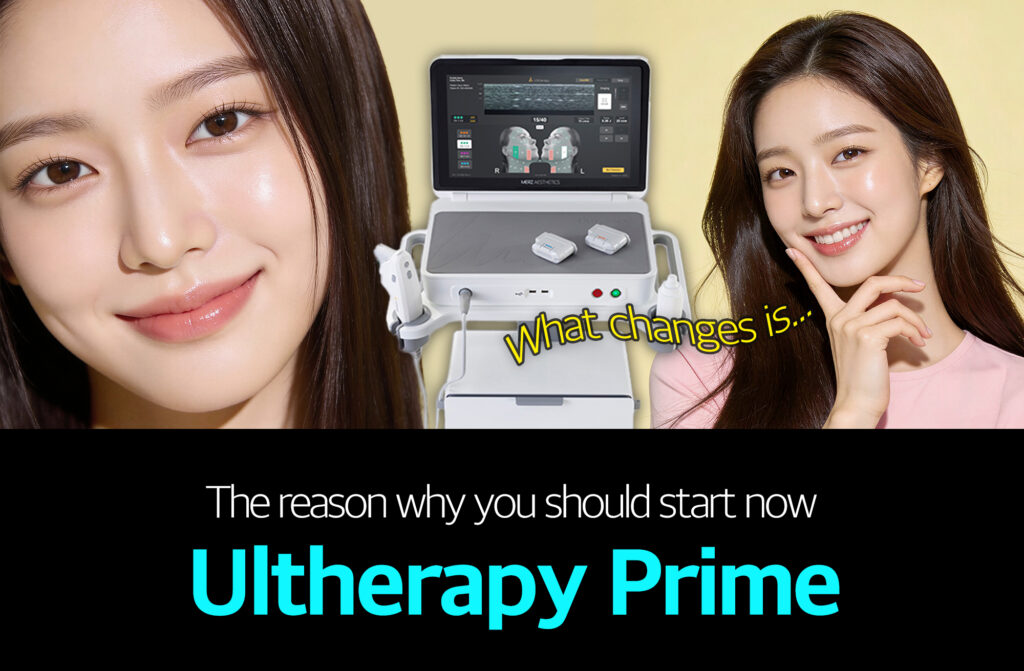
The most common concerns for those considering Ultherapy are the “number of lines” and its “actual effectiveness.”
In particular, many are curious whether 300 lines of Ultherapy are sufficient
and how the trending ‘Ultherapy Prime’ differs from conventional devices.
We will provide a clear explanation of why ‘Jfeel’s Ultherapy Prime’ stands out among countless lifting procedures.
Why should you choose Ultherapy Prime performed by an ‘Institutor’?
While everyone talks about Ultherapy, very few establish its core principles and clinical standards.
The head director of Jfeel Clinic in Gangnam is more than just an experienced practitioner; he serves as an ‘Institutor,’ providing official education and academic guidelines for Ultherapy.
We provide 1:1 customized designs tailored to each individual’s skin thickness and degree of sagging.
What is Ultherapy Prime?
Ultherapy Prime is an upgraded lifting procedure engineered for
more precise energy delivery compared to conventional Ultherapy.
By accurately delivering energy to the SMAS layer rather than just the skin surface,
it ensures superior skin elasticity and lifting results.
A key feature is its ability to provide customized design treatments tailored to each individual’s unique facial structure.
Are 300 Lines of Ultherapy Effective?
While 300 lines may not be the universal answer for everyone, the bottom line is that 300 lines of Ultherapy can effectively assist with basic elasticity improvement and facial contouring.
However, the required number of lines may vary depending on factors such as facial size,
the degree of skin sagging, and fat volume.
Generally, 300 lines can be effective for jawline-focused lifting or mild elasticity improvement. That said, a higher shot count may be necessary for comprehensive full-face lifting or more dramatic results.
The success of Ultherapy depends on the following key factors:
✅Depth selection (1.5mm, 3.0mm, and 4.5mm)
✅Strategic shot distribution per area
✅Energy intensity adjustment
✅Full-face balance design
✅Personalized treatment design is more critical than the total number of lines.
Personalized treatment design is more critical than the total number of lines.
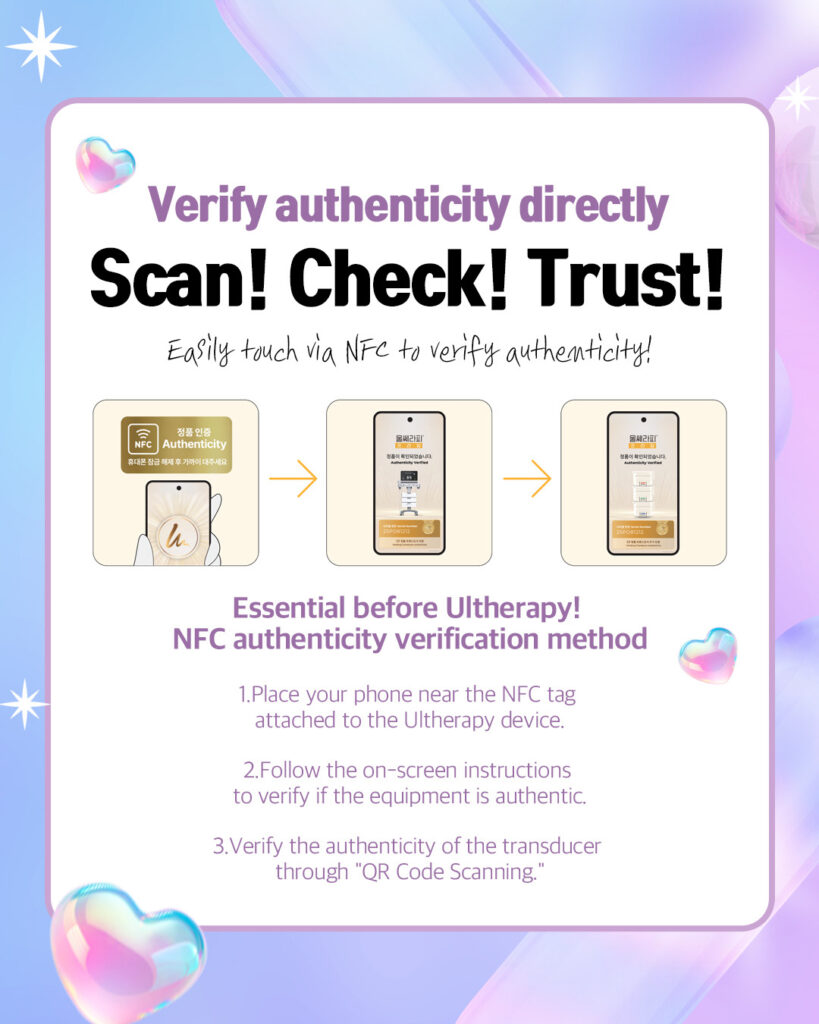
How to verify the authenticity of Ultherapy Prime?
Scan, Check, and Trust! ‘Touch Prime’—the authentic Ultherapy Prime certification.
Ultherapy Prime features an NFC-based genuine verification system called ‘Touch Prime.’
While the outcome of a lifting procedure is important, authenticity, precise dosage,
and accuracy are the essential fundamentals.
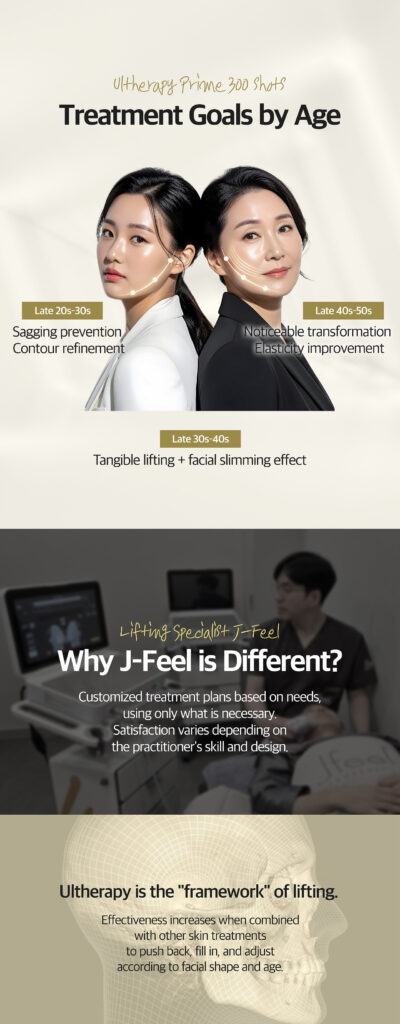
How do Ultherapy treatment goals differ
by age group?
Even when using the same device, the goals and design methods of
Ultherapy Prime vary depending on the patient’s age and skin condition.

Late 20s to 30s: Focus on Sagging Prevention and Contour Refinement
This stage is characterized by the onset of a blurred jawline, subtle cheek sagging,
and loss of skin elasticity rather than visible aging.
Focusing on maintaining elasticity by gently stimulating the SMAS layer and prioritizing jawline refinement.
Prioritizing a balanced design over excessive shots, with lower face tightening for a facial slimming effect.
The goal is not a “drastic transformation” but rather “preventative lifting” to delay the sagging process.

Late 30s to 40s: Focus on Lifting and Visible Facial Slimming Effects
From this stage, structural changes such as sagging cheeks, deepening nasolabial folds,
and the formation of a double chin become more apparent.
Core design focused on 3.0mm and 4.5mm depths, intensive lower face lifting,
and vector placement aligned with the direction of sagging.
Combining fat reduction and volume enhancement as needed.
The goal is visible lifting results and significant contour improvement.
During this period, not only does skin elasticity decrease,
but sagging of the SMAS layer and volume loss also occur simultaneously.
Intensive SMAS layer targeting, active use of 4.5mm depth,
and reinforced design for neck wrinkles and nasolabial folds.
A multi-faceted approach combining lifting, volume, and skin elasticity.
The goal is structural lifting and elasticity recovery.
Customized combination programs are often recommended over standalone treatments.